
Space science, 2 minute read
Space Telescopes: Hubble and Webb
Why put a telescope in space? See what the Hubble Space Telescope and the James Webb Space Telescope do, why Webb looks in infrared and where the pictures in this app come from.
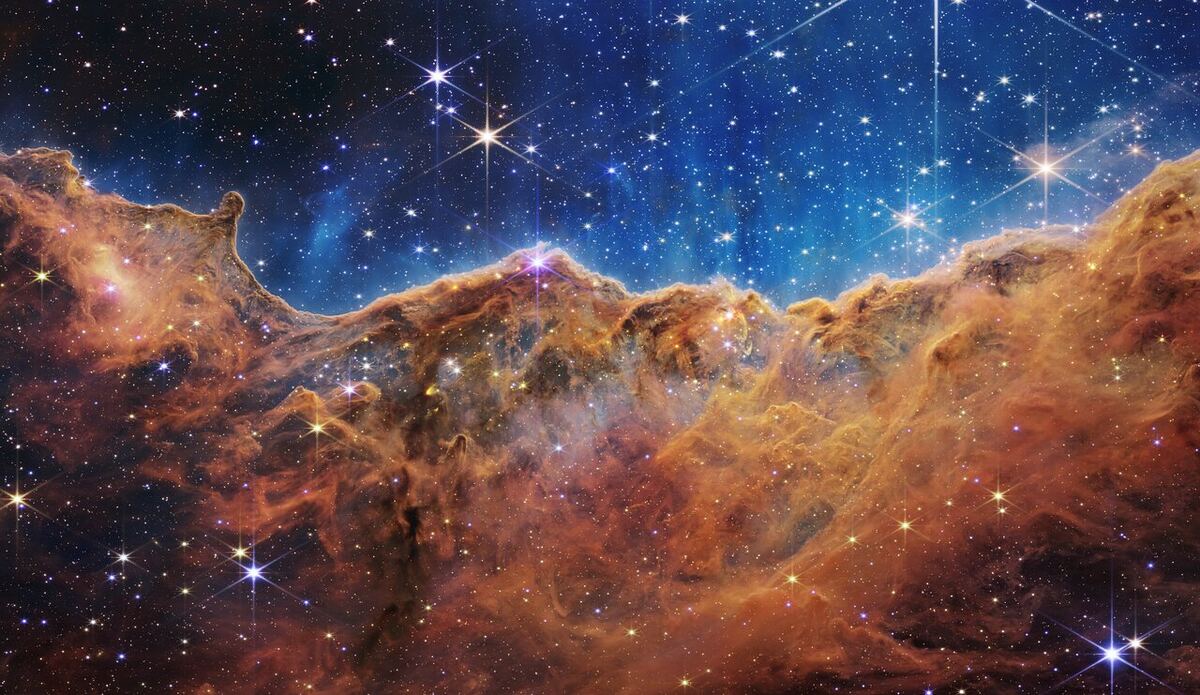
Telescopes on the ground have to look through the Earth's atmosphere. The air makes stars twinkle and blurs fine detail, it blocks most ultraviolet light and much of the infrared, and city lights and clouds get in the way. A telescope in space has none of these problems.
Hubble Space Telescope
- Launched in April 1990 and still working.
- Orbits about 540 km above the Earth, going around once every 95 minutes or so.
- Has a 2.4 m mirror and sees visible light, ultraviolet and some infrared.
- Its mirror was made slightly the wrong shape, so the first pictures were blurred. In 1993 astronauts fitted corrective optics, like giving the telescope glasses, and Hubble then took the sharp images that made it famous.
Hubble has helped measure the age and expansion rate of the Universe and has photographed galaxies billions of light-years away.
James Webb Space Telescope
- Launched on 25 December 2021.
- Has a 6.5 m mirror made of 18 hexagonal segments coated in gold, which reflects infrared light very well. It folded up for launch and unfolded in space.
- Looks mostly at infrared light. Infrared passes through dust clouds, so Webb can see stars being born and, because the Universe's expansion stretches light from very distant galaxies into the infrared, it can see some of the earliest galaxies.
- Sits about 1.5 million km from the Earth, on the side away from the Sun, at a point called L2, where the Earth and Sun's gravity let it keep station.
- A sunshield about the size of a tennis court keeps its instruments very cold, below −200 °C. If the telescope were warm, its own heat would glow in the infrared and drown out the faint signals it is looking for.
Webb's first full-colour images were released in July 2022.
Why it matters for you
Pictures from Hubble and Webb are shared freely with a credit line. Many of the space photographs in this app come from ESA and NASA missions, and each one is credited under its archive's licence. Telescope time is limited, but the data are public, so students anywhere can download real observations and study them.
Sources
Part of the course Space Technology and Dark Skies.