
Observing, 2 minute read
Binoculars and Telescopes
Why the size of the lens matters more than magnification, why binoculars are the best first instrument, and how the great telescopes of southern Africa and space see the Universe.
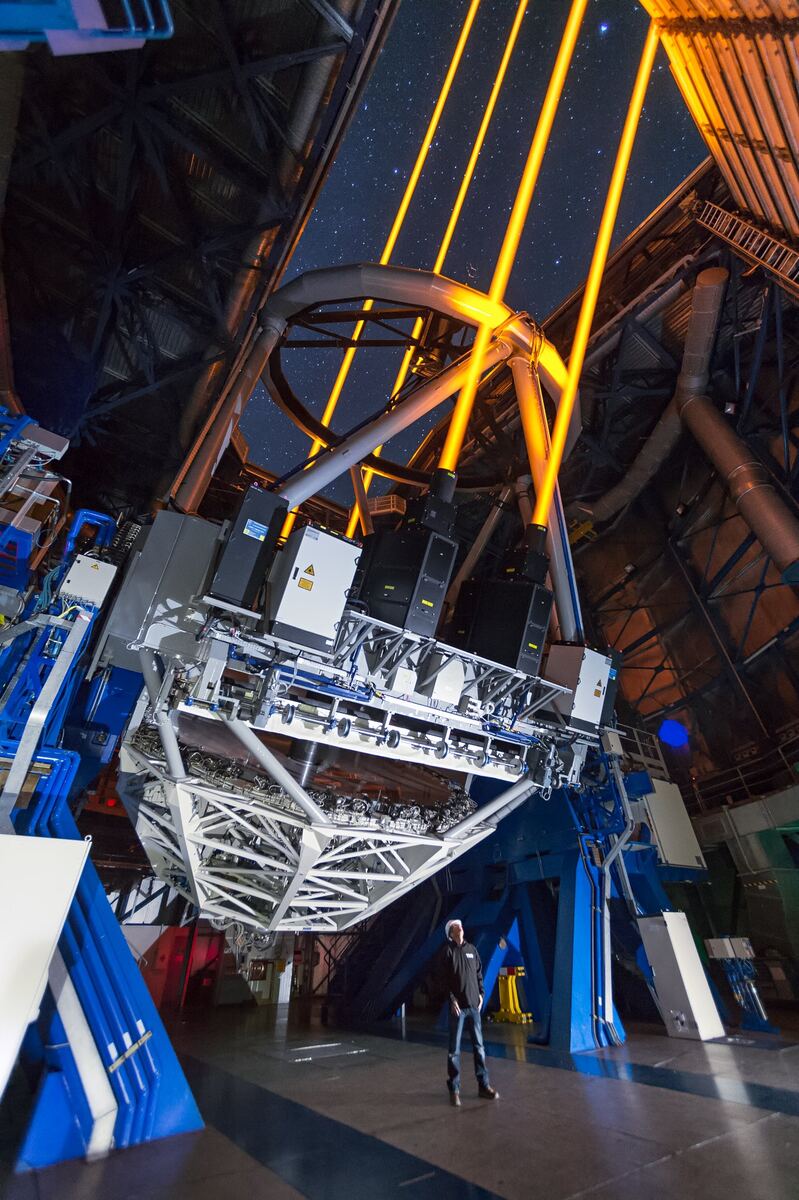
A telescope does two jobs. It collects more light than your eye, so you can see fainter things, and it shows finer detail. Magnification is the least important of its powers.
Aperture is everything
The aperture is the diameter of the main lens or mirror. The light a telescope gathers depends on its area: a 100 mm telescope collects about four times as much light as a 50 mm one, and roughly 200 times as much as the dark-adapted human eye. A bigger aperture also shows finer detail.
Magnification is the telescope's focal length divided by the eyepiece's focal length. A 1,000 mm telescope with a 25 mm eyepiece magnifies 40 times. Too much magnification just makes a dim, blurry, shaking image. Be wary of cheap telescopes advertised with "500× power".
Start with binoculars
Binoculars are labelled like 10×50: they magnify 10 times and each lens is 50 mm across. A pair of 7×50 or 10×50 binoculars is the best first instrument for most people. They are easy to carry, show a wide view, and reveal the Moon's craters, Jupiter's moons, star clusters such as the Jewel Box and the Pleiades, and countless stars in the Milky Way. Lean against a wall or use a tripod to keep them steady.
Kinds of telescope
- Refractors use a lens. Galileo used a small refractor in 1609–1610 to discover Jupiter's moons and the phases of Venus.
- Reflectors use a curved mirror, an idea Isaac Newton pioneered. Large mirrors are easier to make than large lenses, so all big research telescopes are reflectors. A Dobsonian is a simple reflector on a swivelling base: excellent value for beginners.
Great telescopes of southern Africa
- The Southern African Large Telescope (SALT) near Sutherland, South Africa, has a mirror about 10 metres across: one of the largest optical telescopes in the world.
- MeerKAT, a radio telescope of 64 dishes in the Karoo, studies hydrogen gas, pulsars and distant galaxies. It will become part of SKA-Mid, the South African half of the international Square Kilometre Array, with outstations planned across eight African partner countries.
Above the atmosphere
Earth's atmosphere blurs starlight and blocks most infrared, ultraviolet and X-ray light. Space telescopes avoid this. The James Webb Space Telescope, launched on 25 December 2021 with a 6.5-metre mirror, observes in infrared, seeing the first galaxies and the atmospheres of exoplanets.
Sources
Part of the course Observing from Zimbabwe.