
Solar System, 2 minute read
The Giant Planets and Their Moons
Jupiter, Saturn, Uranus and Neptune are worlds of gas, ice and storms with dozens of moons. Meet the biggest planet, the ringed planet, the sideways planet and the windy planet.
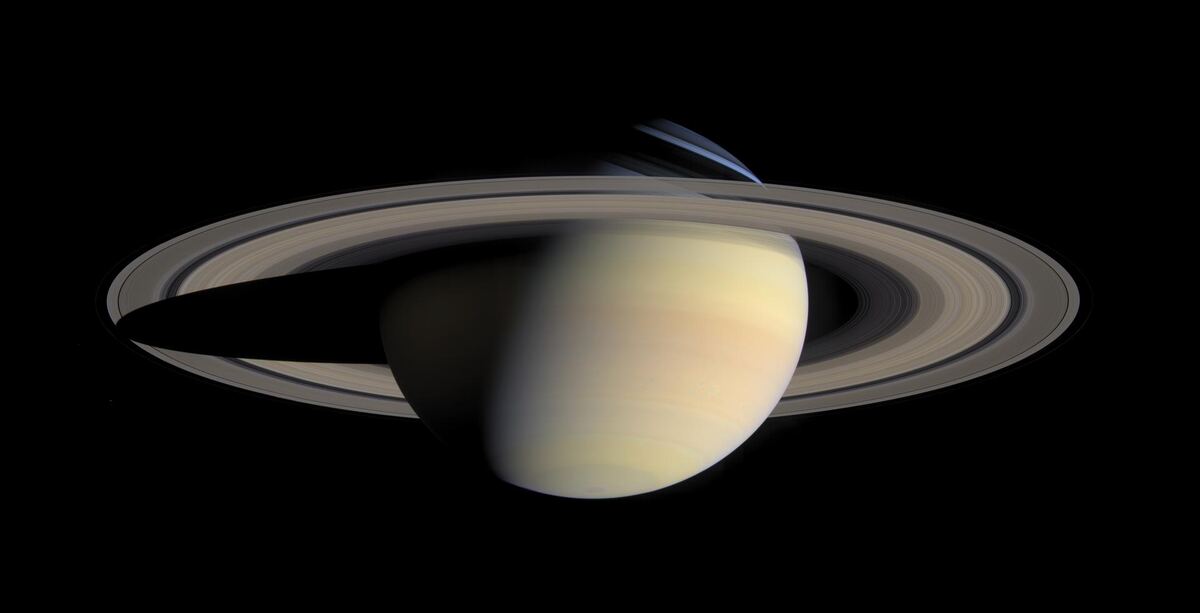
Beyond Mars and the asteroid belt lie the four giant planets. They have no solid surface to stand on, and each is far larger than the Earth.
Jupiter
Jupiter is the largest planet. More than eleven Earths would fit across it, and it holds more than twice the mass of all the other planets put together. It is made mostly of hydrogen and helium. Its Great Red Spot is a storm wider than the Earth that astronomers have watched for well over a century.
In 1610 Galileo pointed an early telescope at Jupiter and found four moons circling it. These Galilean moons are:
- Io, the most volcanic place in the Solar System.
- Europa, with an icy shell over a salty ocean that may be a place to look for life.
- Ganymede, the largest moon in the Solar System, bigger than the planet Mercury.
- Callisto, an ancient, heavily cratered world.
Saturn
Saturn is famous for its rings, made of billions of pieces of ice, from dust grains to lumps as large as houses. The rings are very wide but extremely thin. Saturn is the least dense planet: its average density is lower than water, so in a bath big enough it would float.
Its largest moon, Titan, has a thick atmosphere and lakes of liquid methane and ethane. Another moon, Enceladus, shoots geysers of water ice into space.
Uranus and Neptune
These two are ice giants. Beneath their atmospheres they hold a hot mixture of water, ammonia and methane. Methane in the upper air absorbs red light and gives both planets their blue-green colour.
- Uranus is tipped on its side, with an axis tilted about 98°, so it seems to roll around the Sun.
- Neptune has the fastest winds in the Solar System, above 2,000 km/h. It was found in 1846, after mathematicians predicted its position from small disturbances in the motion of Uranus.
Only one spacecraft, Voyager 2, has ever visited Uranus (1986) and Neptune (1989).
What you can see from Zimbabwe
Jupiter and Saturn are easy to see with the unaided eye when they are above the horizon, and binoculars or a small telescope will show Jupiter's four big moons as tiny points of light. Uranus is just visible from a very dark site, and Neptune needs a telescope. Check the Planets tonight screen in this app to see which are up.
Sources
Part of the course Our Solar System.