
Solar System, 2 minute read
The Inner Planets: Mercury, Venus, Earth and Mars
The four rocky planets closest to the Sun could hardly be more different. Compare scorching Mercury, hellish Venus, our living Earth and rusty, once-wet Mars.
The four planets closest to the Sun are rocky worlds with solid surfaces: Mercury, Venus, Earth and Mars. They are small compared with the giant planets farther out, yet each is its own story.
Mercury
Mercury is the smallest planet, only a little wider than our Moon. It is so close to the Sun that its year lasts just 88 Earth days. With almost no atmosphere to hold in heat, its surface swings from about 430 °C in the day to about −180 °C at night. Its surface is covered in craters, like the Moon's.
Venus
Venus is almost the same size as the Earth, but it is a very different place. A thick atmosphere of carbon dioxide traps heat in a runaway greenhouse effect, so the surface is about 465 °C, hotter than Mercury, even though Venus is farther from the Sun. The air pressure at the surface is about 90 times the Earth's, and the clouds are made of sulphuric acid.
Venus spins very slowly and backwards. One turn takes about 243 Earth days, which is longer than its year of about 225 days. Seen from Zimbabwe it is the bright "morning star" or "evening star", the brightest planet in our sky.
Earth
Earth is the only planet known to have life. Oceans cover about 71% of its surface, and its atmosphere of nitrogen and oxygen, together with its distance from the Sun, keeps water liquid.
Mars
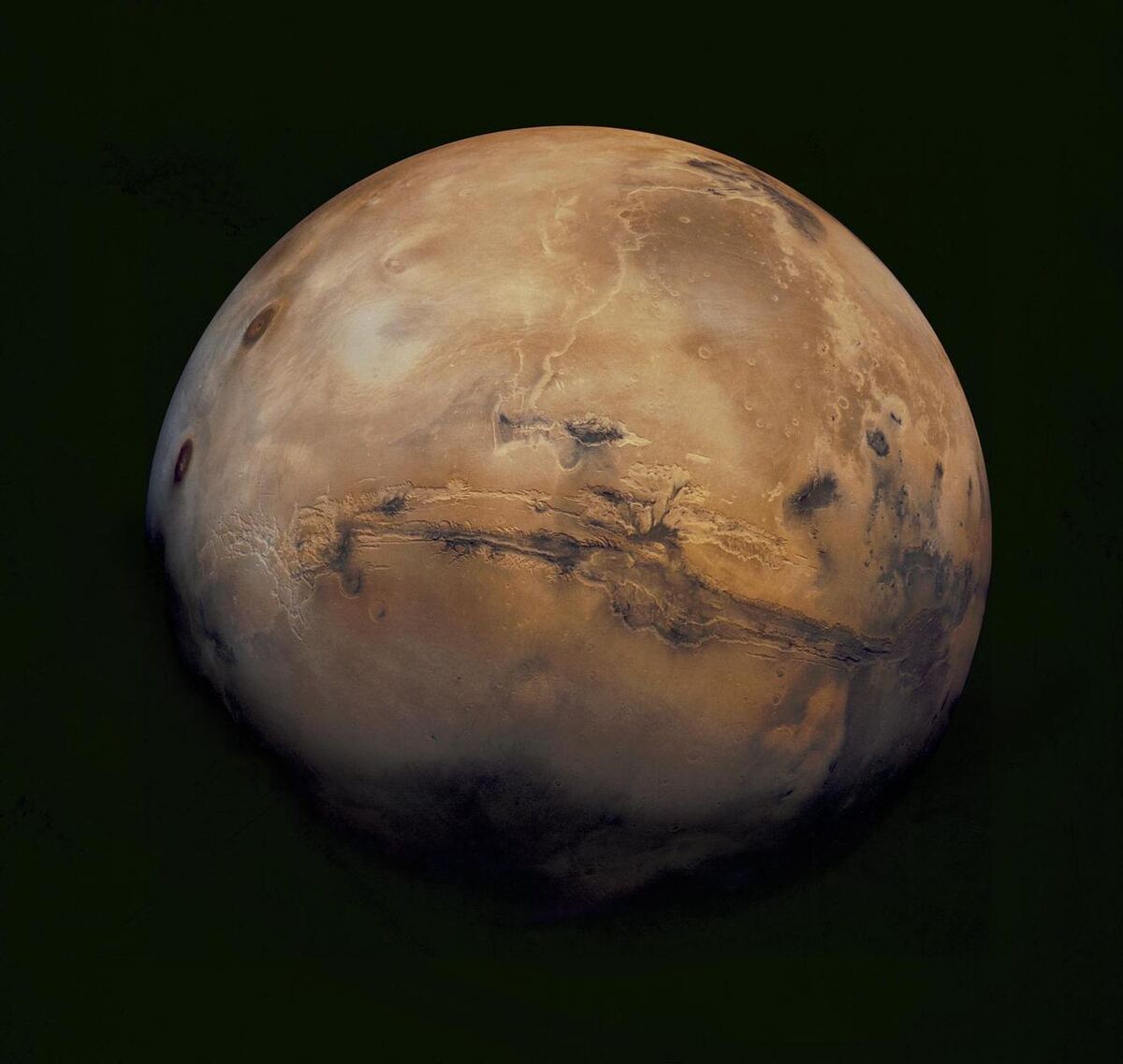
Mars is about half the width of the Earth. Its thin atmosphere is mostly carbon dioxide, with a surface pressure of less than 1% of the Earth's. Its red colour comes from iron oxide, in other words rust, in the dust and rocks.
- Olympus Mons is the tallest known volcano in the Solar System, about 22 km high, roughly two and a half times the height of Mount Everest.
- Valles Marineris is a canyon system about 4,000 km long.
- Rivers, lakes and perhaps an ocean once covered parts of Mars, billions of years ago. Robot rovers such as Curiosity (landed 2012) and Perseverance (landed 2021) are studying the rocks to learn whether life could ever have existed there.
A day on Mars, called a sol, lasts about 24 hours and 37 minutes, very close to ours.
Sources
Part of the course Our Solar System.