
Solar System, 2 minute read
Meteors, Comets and Asteroids
Shooting stars are specks of comet dust burning up high above us. Learn the difference between meteors, meteorites, comets and asteroids, and the best meteor showers to watch from Zimbabwe.
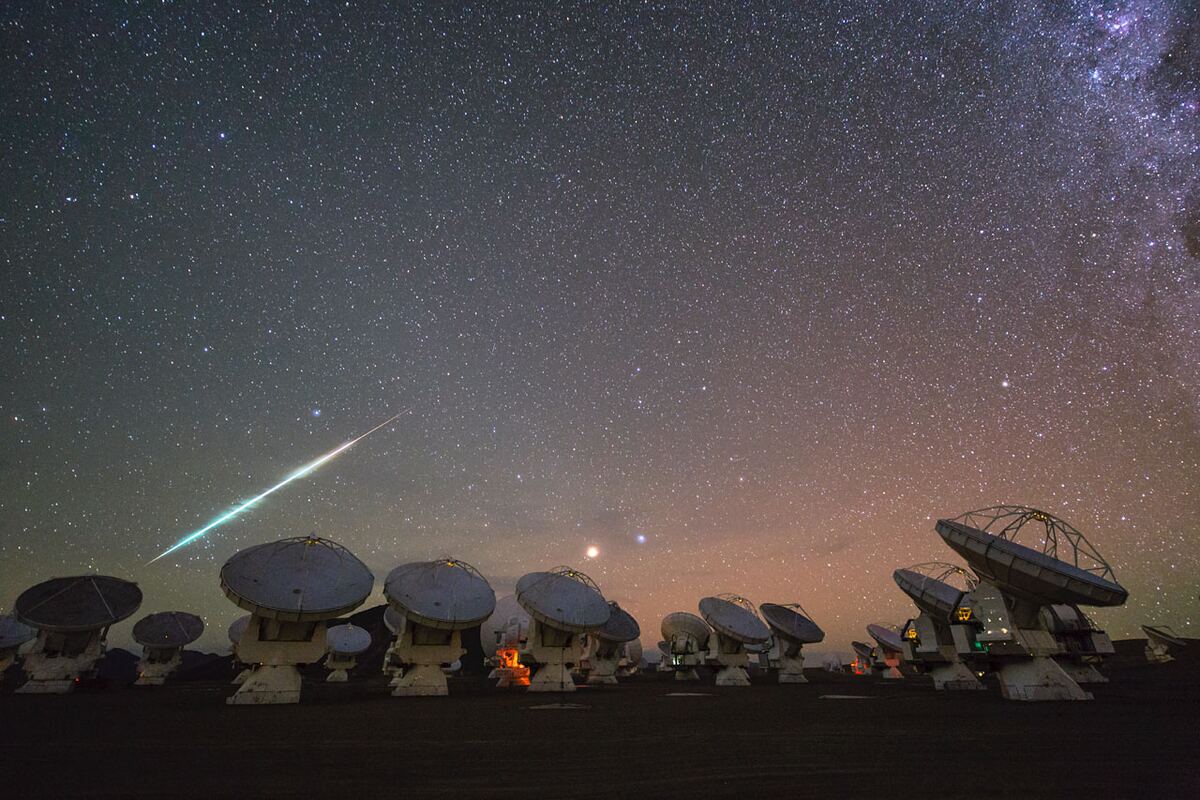
A "shooting star" is not a star at all. It is a meteor: a bright streak made when a speck of rock or dust from space hits Earth's atmosphere at tens of kilometres per second and burns up, usually around 80 to 120 km above the ground. The Karanga of Zimbabwe are recorded as greeting a meteor with a shout, "Li-i-I Thobela!", believing a god or ancient chief was crossing the sky.
The names
- A meteoroid is the small piece of rock or dust while it is still in space.
- A meteor is the streak of light it makes in the atmosphere.
- A meteorite is a piece that survives the fall and reaches the ground. Most are fragments of asteroids.
- An asteroid is a rocky or metallic body, from a few metres to hundreds of kilometres across. Most orbit the Sun between Mars and Jupiter.
- A comet is a lump of ice and dust from the cold outer Solar System. When it comes close to the Sun, the ice turns to gas and forms a glowing head and long tails.
Meteor showers
As comets travel around the Sun, they leave trails of dust along their orbits. When Earth passes through a trail, we get a meteor shower: many meteors that all seem to come from one point in the sky, the radiant. Showers are named after the constellation that holds the radiant.
Good showers for Zimbabwe, according to the International Meteor Organization's calendar:
- Eta Aquariids, peaking around 5–6 May. Dust from Halley's Comet. The radiant is best placed for the southern tropics, so Zimbabwe gets a better view than most of the world. Watch in the hours before dawn.
- Southern Delta Aquariids, peaking around the end of July, again favouring southern observers.
- Geminids, peaking around 13–14 December. One of the richest showers of the year, made by debris from the asteroid 3200 Phaethon.
Rates are given as a ZHR (zenithal hourly rate): the number one observer would see under a perfectly dark sky with the radiant overhead. Real counts are lower, especially when the Moon is bright.
How to watch
Go somewhere dark, lie back on a mat, let your eyes adapt for 20 to 30 minutes and look at a wide area of sky. No telescope needed: meteors are best seen with the naked eye.
Planetary defence
Large impacts are rare, but astronomers track near-Earth asteroids carefully. In 2022 NASA's DART spacecraft deliberately crashed into the small asteroid Dimorphos and changed its orbit, the first test of a way to push a dangerous asteroid aside.
Sources
- OpenStax Astronomy 2e, 14.1 Meteors
- OpenStax Astronomy 2e, 13.3 The "Long-Haired" Comets
- OpenStax Astronomy 2e, 13.2 Asteroids and Planetary Defense
- International Meteor Organization: meteor shower calendar
- NASA Science: Meteors and meteorites
- NASA: DART mission
- Astronomical Society of Southern Africa: African ethnoastronomy
Part of the course Observing from Zimbabwe.