
Space science, 3 minute read
The Life of a Star
Stars are born in clouds of gas, shine by fusing hydrogen for billions of years, and die as white dwarfs, neutron stars or black holes. Their deaths made the elements in your body.
Stars are not eternal. They are born, they shine for millions or billions of years, and they die. Which path a star follows depends almost entirely on one thing: its mass.
Birth in a cloud
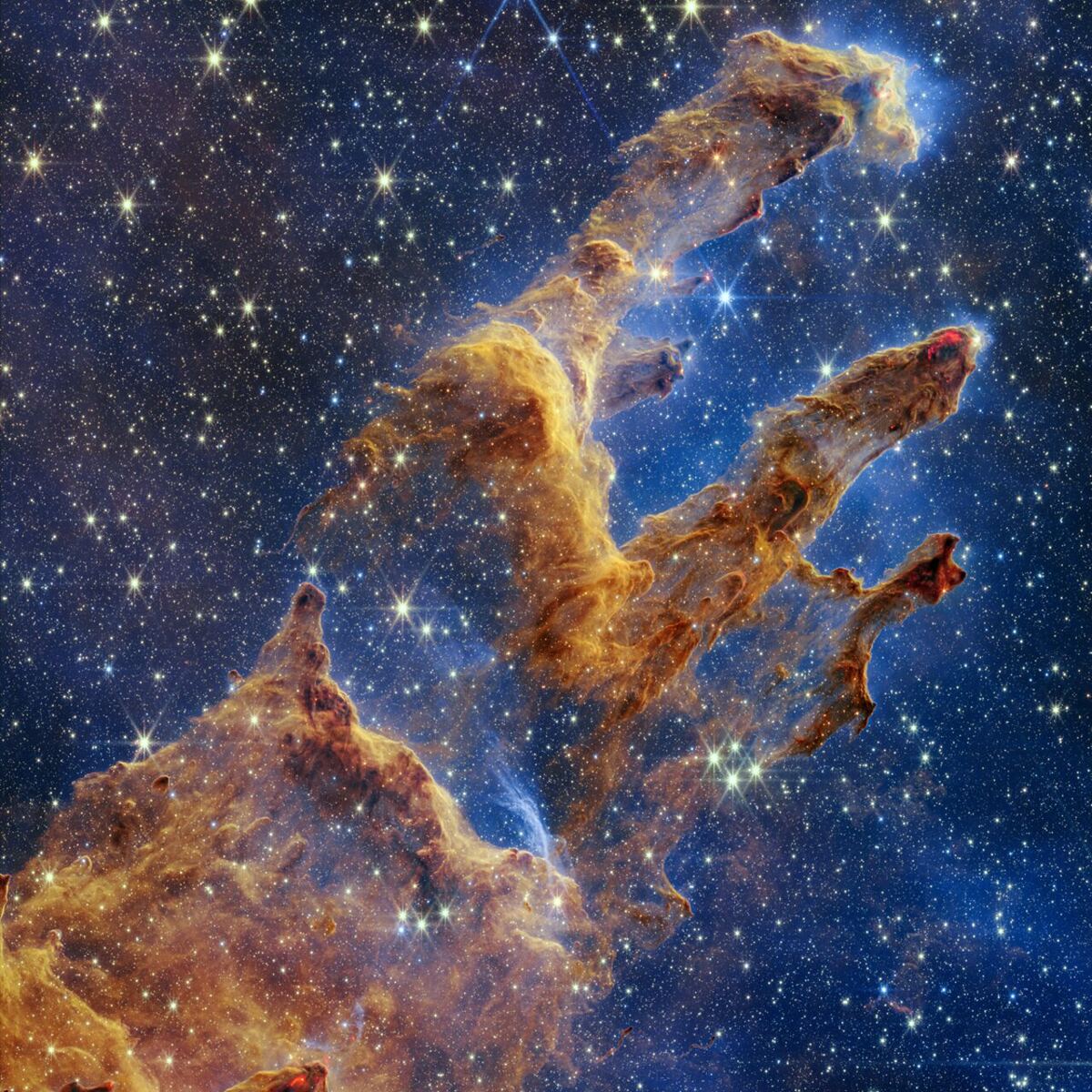
Stars form inside huge, cold clouds of gas and dust, called nebulae. When part of a cloud becomes dense enough, gravity makes it collapse. The collapsing clump heats up and becomes a protostar, often surrounded by a flat disc of material from which planets can form. The Orion Nebula, visible to the naked eye below Orion's Belt, is a stellar nursery only about 1,300 light-years away.
A long, steady life
When the centre reaches about 10 million degrees, hydrogen nuclei begin to fuse into helium, releasing enormous energy. The star settles down on the main sequence, where it spends about 90% of its life, held in balance between gravity pulling in and pressure pushing out.
- The Sun is about 4.6 billion years old, roughly halfway through a main-sequence life of about 10 billion years.
- Massive stars burn their fuel far faster. A star 20 times the Sun's mass lasts only about 10 million years.
- A star's colour shows its surface temperature: blue-white stars are hottest, red stars coolest.
The death of a Sun-like star
When the hydrogen in the core runs out, the core shrinks and heats while the outer layers swell. The star becomes a red giant, hundreds of times larger. In about 5 billion years the Sun will expand towards Earth's orbit. Eventually the outer layers drift away as a glowing shell, a planetary nebula, and the exposed core remains as a white dwarf: about the size of Earth, but with roughly half the Sun's mass, slowly cooling.
The death of a massive star
Stars of more than about 8 solar masses fuse heavier and heavier elements in their cores, up to iron. Fusing iron releases no energy, so the core collapses in less than a second and the star explodes as a supernova, briefly outshining an entire galaxy. What remains is either a neutron star, a city-sized ball of neutrons, or, for the most massive stars, a black hole.
Red supergiants close to their end include Antares in Scorpius and Betelgeuse in Orion, both easy to see from Zimbabwe.
We are made of star stuff
The hydrogen in your body dates back to the Big Bang. Almost everything else, the carbon in your cells, the oxygen you breathe and the calcium in your bones, was made inside stars and scattered by their deaths. The gold in jewellery comes largely from violent events such as collisions of neutron stars, first observed directly in 2017.
Sources
- OpenStax Astronomy 2e, 21.1 Star Formation
- OpenStax Astronomy 2e, 22.1 Evolution from the Main Sequence to Red Giants
- OpenStax Astronomy 2e, 23.1 The Death of Low-Mass Stars
- OpenStax Astronomy 2e, 23.2 Evolution of Massive Stars: An Explosive Finish
- OpenStax Astronomy 2e, 20.5 The Life Cycle of Cosmic Material
Part of the course Stars, Galaxies and the Universe.