
Space science, 2 minute read
Black Holes
Places where gravity is so strong that not even light can escape. Learn how black holes form, how astronomers find something invisible, and what the first black hole images showed.
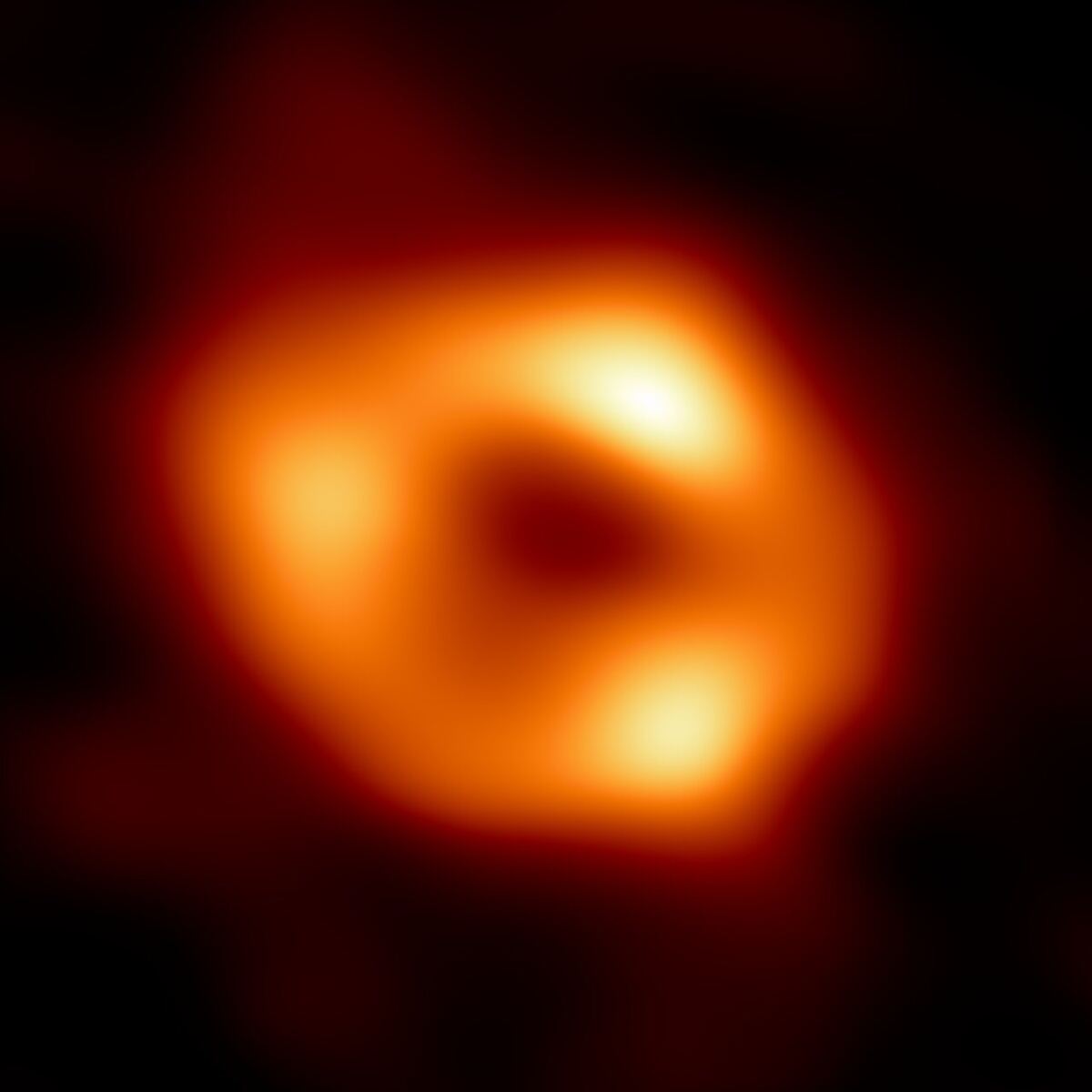
A black hole is a region of space where matter is packed so tightly that gravity stops anything, even light, from escaping. Black holes are not cosmic vacuum cleaners: far away, a black hole pulls on things just like any other object of the same mass. It is only up close that things become extreme.
The event horizon
The boundary of a black hole is the event horizon: the point of no return. Inside it, the speed needed to escape would be greater than the speed of light, which nothing can reach. A black hole with the mass of the Sun would have an event horizon only about 6 km across.
Two main kinds
- Stellar-mass black holes form when very massive stars collapse at the end of their lives. They have a few to a few dozen times the mass of the Sun.
- Supermassive black holes, millions to billions of times the Sun's mass, sit at the centres of most large galaxies, including our own.
Finding something invisible
We cannot see a black hole itself, but we can see its effects:
- Orbiting stars. For decades, astronomers tracked stars racing around the centre of the Milky Way. Their orbits showed an invisible object of about 4 million solar masses in a tiny space: the black hole Sagittarius A*. Reinhard Genzel and Andrea Ghez shared the 2020 Nobel Prize in Physics for this work, with Roger Penrose for his theory of black hole formation.
- Hot discs of gas. Gas spiralling in heats up to millions of degrees and shines in X-rays. Cygnus X-1 was one of the first black holes found this way.
- Gravitational waves. On 14 September 2015 the LIGO detectors recorded ripples in space-time from two black holes merging 1.3 billion light-years away, the first direct detection of gravitational waves.
The first pictures
The Event Horizon Telescope links radio dishes across the world into one Earth-sized telescope. In 2019 it released the first image of a black hole's shadow, in the galaxy M87, about 6.5 billion times the Sun's mass. In 2022 it released an image of Sagittarius A*, the black hole at the heart of our galaxy, about 27,000 light-years away in the direction of Sagittarius, overhead on Zimbabwe's winter evenings. Both show a bright ring of glowing gas around a dark centre, exactly as Einstein's theory of general relativity predicts.
Sources
Part of the course Stars, Galaxies and the Universe.