
Solar System, 2 minute read
The Sun, Our Star
The Sun is an ordinary star, but it is the one that gives us light, warmth and weather. Learn what it is made of, how it shines, what sunspots are and why solar storms matter.
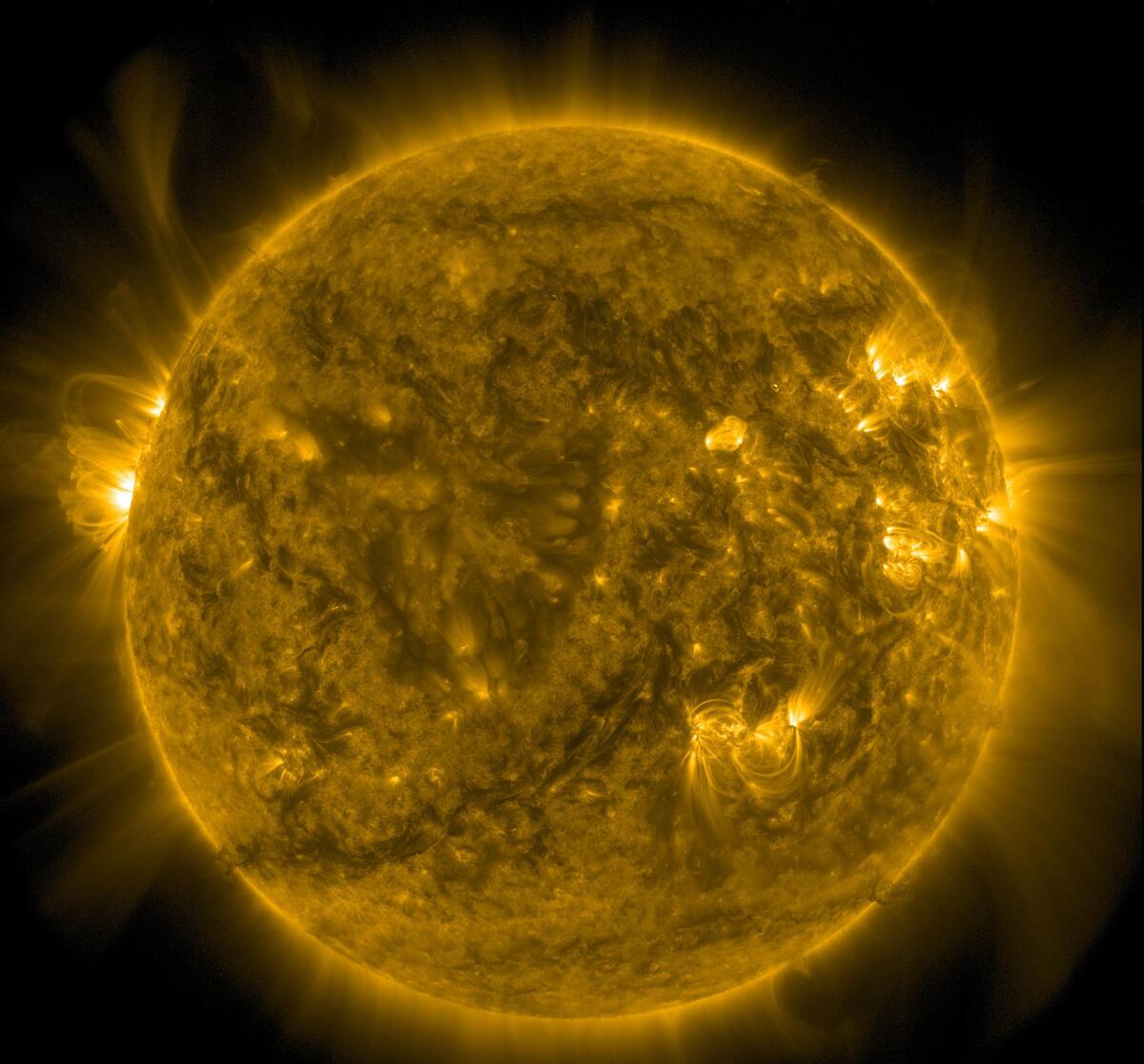
The Sun is a star: a huge ball of hot gas that makes its own light. It looks different from the other stars only because it is so much closer. Its light takes about 8 minutes and 20 seconds to reach us, while light from the next nearest star takes over four years.
How big and how hot
- The Sun is about 1.39 million km across, roughly 109 times the width of the Earth.
- It holds more than 99.8% of all the mass in the Solar System. The planets, moons and asteroids together are a tiny leftover.
- Its visible surface is about 5,500 °C. The centre, the core, is about 15 million °C.
- It is about 4.6 billion years old and is roughly halfway through its life as a steady, hydrogen-burning star.
How the Sun shines
Deep in the core, the pressure and heat are so great that hydrogen nuclei are squeezed together to make helium. This is nuclear fusion. Each second the Sun turns about 4 million tonnes of its matter into energy. That energy slowly works its way out, taking thousands of years to reach the surface, and then flies off as light and heat.
What we see on the surface
The bright surface is the photosphere. Dark patches called sunspots appear on it. They look dark only because they are cooler than the gas around them, and they mark places where strong magnetic fields are pushing through. The number of sunspots rises and falls in a cycle of about 11 years. Near the top of the cycle the Sun is more active.
Above the surface, flares and giant clouds of gas called coronal mass ejections are thrown out into space. The Sun also blows a constant stream of charged particles, the solar wind.
Why solar storms matter to us
When a burst of particles reaches Earth, it meets our magnetic field. Most of it is steered away, and some of it flows down near the poles and makes the glowing curtains of the aurora. A strong storm can also disturb radio signals and GPS, damage satellites and, in extreme cases, overload power grids. Forecasters watch the Sun to warn the people who run these systems. This is called space weather.
A safety reminder
Never look at the Sun directly, with or without binoculars or a telescope. It can blind you in seconds. Read our lesson Observing the Sun Safely before you try to watch sunspots or an eclipse.
Sources
Part of the course Our Solar System.