
Solar System, 2 minute read
Eclipses of the Sun and Moon
Why eclipses happen, why they do not happen every month, how to watch them safely, and the eclipses coming up for southern Africa.
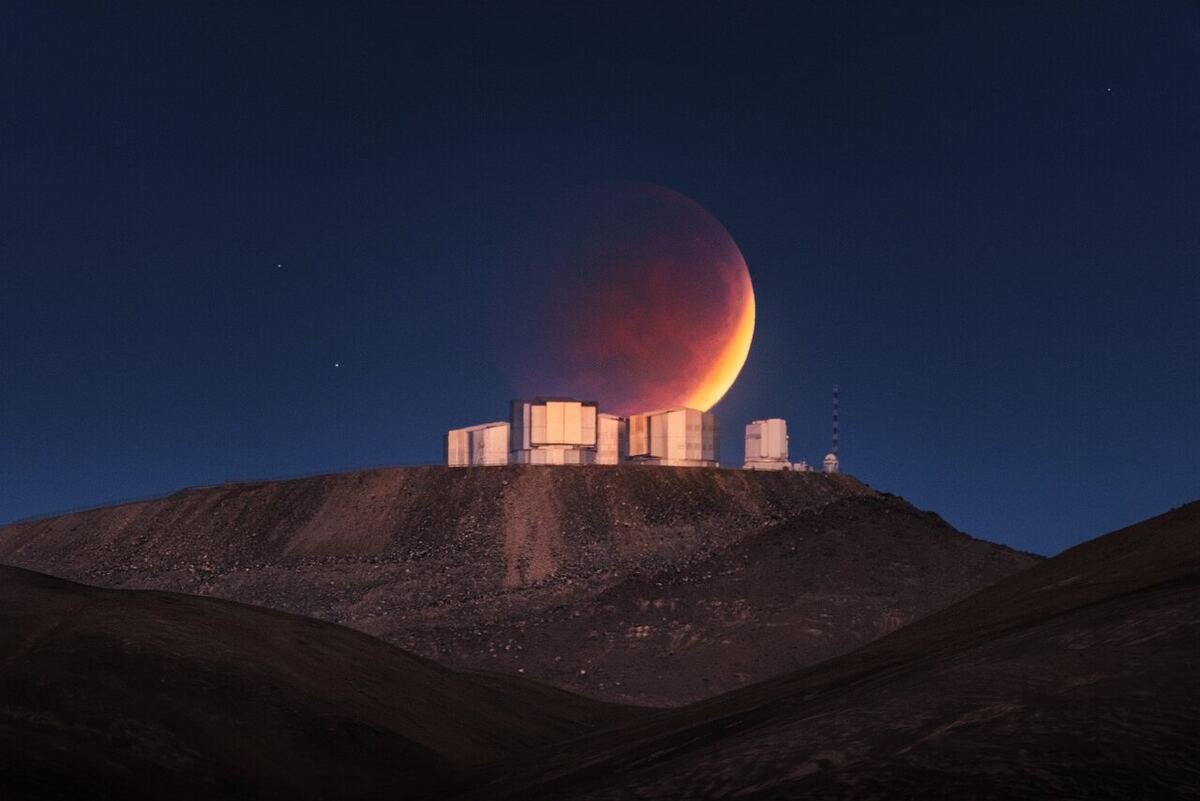
An eclipse happens when the Sun, Earth and Moon line up so that one body's shadow falls on another. The Venda name for a solar eclipse, mutsha-kavhili, means "the two dawns", a perfect description of daylight fading and then returning.
Two kinds of eclipse
- A solar eclipse happens at new Moon, when the Moon passes in front of the Sun and its shadow falls on Earth. Only people inside the shadow see it.
- A lunar eclipse happens at full Moon, when the Moon passes through Earth's shadow. Everyone on the night side of Earth can see it at the same time.
Why not every month?
The Moon's orbit is tilted by about 5 degrees compared with Earth's orbit around the Sun. Most months the new Moon passes a little above or below the Sun, and the full Moon misses Earth's shadow. Eclipses only happen during "eclipse seasons", roughly every six months, when the line-up is close enough.
A cosmic coincidence
The Sun is about 400 times wider than the Moon, but also about 400 times farther away, so the two look almost exactly the same size in our sky. That is why the Moon can just cover the Sun in a total solar eclipse, revealing the Sun's faint outer atmosphere, the corona. When the Moon is near the far point of its orbit it looks slightly too small, and we get an annular ("ring") eclipse instead.
Why the eclipsed Moon turns red
During a total lunar eclipse the Moon rarely disappears. Earth's atmosphere bends some sunlight into the shadow, and like a sunset it filters out blue light, so the Moon glows a coppery red.
Watching safely
- Lunar eclipses are completely safe to watch with your eyes, binoculars or a telescope.
- Never look at a solar eclipse without proper protection. Use eclipse glasses that meet the ISO 12312-2 standard, or project the Sun's image. The only safe moment to look directly is during totality itself, which very few places ever see. The lesson on observing the Sun safely explains how.
Coming up for southern Africa
On 25 November 2030, the path of a total solar eclipse crosses Namibia, Botswana, South Africa and Lesotho. From Zimbabwe it will be a partial eclipse, and a short trip south-west can put you in the path of totality. Check a reliable eclipse calculator for exact times where you live, and watch the ZAS app for events.
Sources
Part of the course Astronomy Foundations.