
Research skills, 2 minute read
Light: The Astronomer’s Messenger
Almost everything we know about the Universe comes from light. Learn the electromagnetic spectrum, how spectra reveal what stars are made of, and how colour and redshift give temperature and motion.
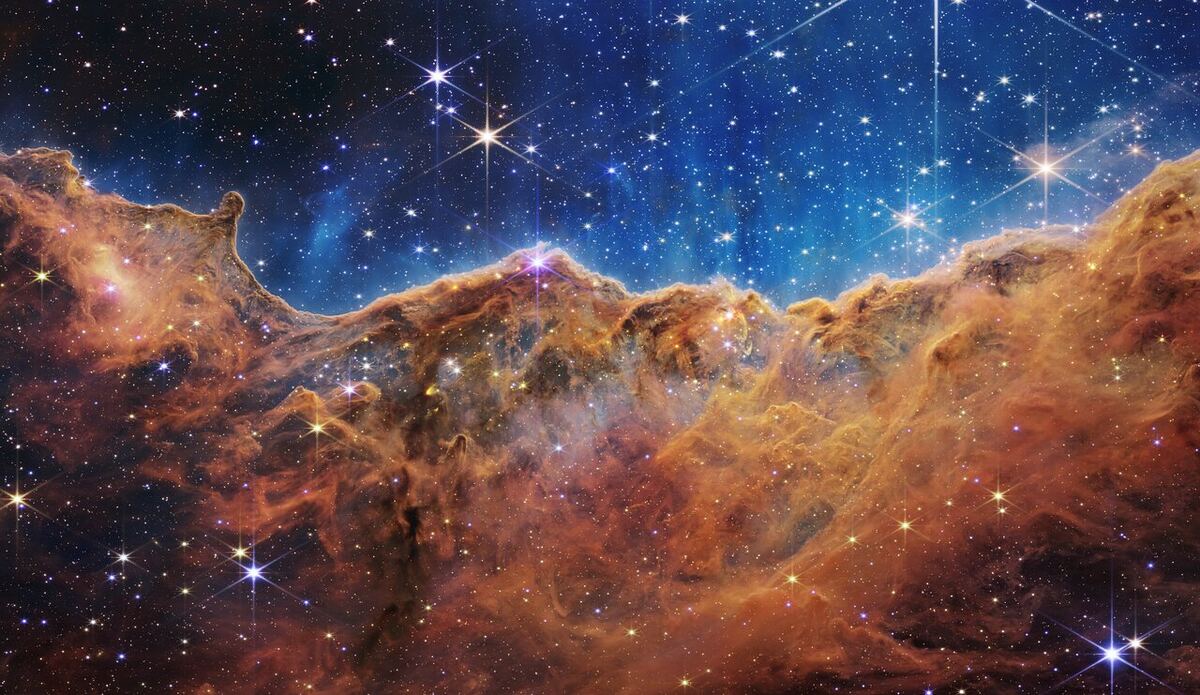
We cannot touch a star, but its light carries a remarkable amount of information across space. By spreading it out and measuring it carefully, astronomers learn what the star is made of, how hot it is and how it is moving.
More than our eyes can see
Visible light is only a small part of the electromagnetic spectrum. From the longest wavelengths to the shortest:
- Radio waves reveal cold hydrogen gas, pulsars and jets from black holes.
- Infrared passes through dust, into regions where stars and planets are forming.
- Visible light shows stars and galaxies as our eyes would see them.
- Ultraviolet, X-rays and gamma rays reveal very hot gas and violent events.
Earth's atmosphere lets through visible light and radio waves but blocks most of the rest. That is why radio telescopes such as MeerKAT work on the ground, while X-ray and most infrared telescopes must go into space.
Colour is temperature
Hot objects glow, and the hotter they are, the bluer their light. A red star such as Antares has a surface of about 3,500 kelvin; the Sun is about 5,800 kelvin and looks white from space; blue-white stars can exceed 20,000 kelvin. Astronomers sort stars into spectral classes O, B, A, F, G, K and M, from hottest to coolest. The Sun is a G star.
Spectroscopy: the barcode of the elements
Spread light into a rainbow, a spectrum, and you find narrow dark or bright lines. Each chemical element absorbs and emits light only at its own particular wavelengths, so its lines form a unique pattern, like a barcode.
This is how we know the Sun is mostly hydrogen and helium. Helium was in fact discovered in the Sun's spectrum in 1868, nearly 30 years before it was found on Earth. Its name comes from Helios, the Greek word for the Sun.
The Doppler effect
When a source moves away from us, its light is stretched to longer, redder wavelengths: a redshift. When it moves towards us, the light is squeezed to bluer wavelengths: a blueshift. Measuring how far the lines have moved gives the speed. It is used to:
- measure how fast stars and galaxies move,
- find planets around other stars, from the tiny wobble they cause,
- show that distant galaxies are moving away from us as the Universe expands.
Sources
Part of the course Astronomy Research Methods.